





About Operational AI
Agents handle operational tasks, coordinate with the patient, close the loop with staff, and document in your EHR. Staff get a handoff, with full patient and conversation context, only when they need to take action.

Owns outcomes
Luma makes sure the right outcome happens (e.g., referral gets scheduled) instead of just moving data (e.g., filing a referral fax).

Works intelligently
Luma weighs your rules, patient context, and the desired outcome to take action (e.g., escalate incomplete procedure prep to staff).

Partners with staff
Luma does not make clinical judgments. Conversations hand off to staff when needed.
Guardrails

Your team defines what each agent can act on. That includes which workflows it handles, which actions it can take in your EHR, what hours it runs, and which information sources it can draw from.
Agents don't give clinical advice, interpret symptoms, or change medications. Agents respect your own workflow boundaries and patients' requests to speak to a human. When agents need to escalate, they'll let the patient know where they're handing off and flag the conversation for your staff.
Every agent honors Do-Not-Contact flags without exception.
Escalations

Escalation rules sit at two levels, the platform and the individual agent, and your team sets the conditions.
When an agent reaches a limit set by your escalation rules, it stops taking action. What happens next follows your policy: notify staff, send a signal into your EHR, or end the engagement with a message your team approved.
On average, agents escalate 3% of engagements.
Audit trail

Your team can see the complete message history for every engagement, along with every action the agent took.
Each conversation includes a post-call analysis and summary. Reporting includes content of every engagement, summary of every engagement, model and vendor used, channel used, and more.
Changes to agent behavior are tracked, including customizations your own staff makes in the platform.
Engagement records are retained as required for HIPAA compliance.
Accuracy

We count an engagement resolved when the agent completes the request end to end, including writing to your EHR.
Faxes are parsed with a 98.7% accuracy rate. Appointment types are selected correctly 100% of the time.
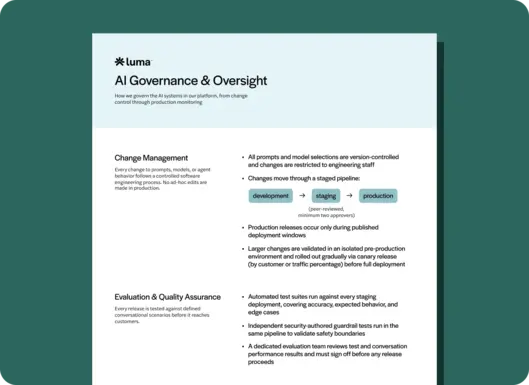
Every release is tested against defined conversational scenarios before it reaches you. Each release runs 500+ test cases covering accuracy, expected behavior, and edge cases. Security guardrails are tested separately. A dedicated evaluation team reviews the results and signs off before a release moves forward.
Every live engagement is automatically reviewed to improve accuracy rates and reduce transfers and escalations, and our team manually reviews hundreds of live engagements every month. What that review finds goes back into the next round of testing.
Our models
Luma is healthcare-native. But most AI research happens outside healthcare, and the best models get better faster than a homegrown model can keep up.
We pick the best models available from OpenAI, Anthropic, and ElevenLabs, choosing the model to the task (a reasoning model for referral packets, more agile models for phone calls).
Then, we apply guardrails for healthcare. Luma controls what each model can see, what it can do, and when it hands off to staff. Those rules come from 11 years of healthcare data and more than a billion patient interactions.
When better models become available, we test, validate, and swap them in. Your workflows and guardrails stay the same, just with improved performance.