The Patient at the Center: PCC and Luma Partner for Better Pediatrics Communication
In pediatrics, the person receiving a text from the doctor’s office usually isn’t the patient.
It might be Mom confirming an appointment, Dad asking a follow-up question, or another caregiver trying to reschedule. The same phone number might be connected to two or three siblings. As children get older, who should receive which communication can change. Even a simple appointment reminder has to account for the family relationships around the child.
The need for patient-centered pediatric communication that is easy for staff to manage brought Physician’s Computer Company (PCC) and Luma’s Operational AI platform together as partners. Soon, Luma’s communication will be available natively in the PCC EHR, for all 300+ pediatric practices PCC serves.
Practices will be able to send appointment reminders and targeted broadcasts, have two-way conversations with patients and families, and communicate in more than 30 languages.
The need for child-centered communication in pediatrics
For more than 40 years, PCC has been dedicated to the needs of independent pediatricians. As part of that work, PCC set out to improve how pediatric practices communicate with patients and families.
PCC spent over a year asking its customers what they wanted to do differently. They learned that staff at these practices were juggling appointment reminders, phone calls, individual messages, and group communications, often using separate tools alongside PCC. Staff had to be the source of truth across all of these tools.
“We know pediatrics, and we know our customers,” said Jim Leahy, Application Specialist at PCC. “We needed a partner that understood and accounted for the unique needs of these practices.”
As PCC started evaluating potential partners, they found that many communication platforms centered on a contact and that person’s phone number. Luma organizes communication around the patient, with parents, guardians, and other caregivers connected to that patient.
“What stood out to us about Luma was that the child stays at the center, and the parents and caregivers are connected around them,” said Leahy. “That’s much closer to how our practices actually work.”
The teams are now building pediatric-specific enhancements, including labeling a contact as a mother, father, caregiver, or someone else associated with the child. They’re also accounting for situations where communication needs to remain separate among different parents, caregivers, or older children.
Those details reduce the mental work for staff. Instead of having to hunt down family context, staff have it with each message.
Why PCC and Luma chose to build together
After more than 40 years focused exclusively on independent pediatric practices, PCC knew what it wanted in a partner.
“Our job isn’t to build every piece of technology ourselves. It’s to make sure our clients have the best tools for independent pediatrics,” said Chip Hart, CEO of PCC. “When we find a partner who does something exceptionally well and shares our commitment to our customers, we can combine what each of us knows and build something better than either of us could build alone.”
Luma brought its own experience in pediatrics, with many active pediatric customers including Children’s Minnesota and Tenafly Pediatrics.
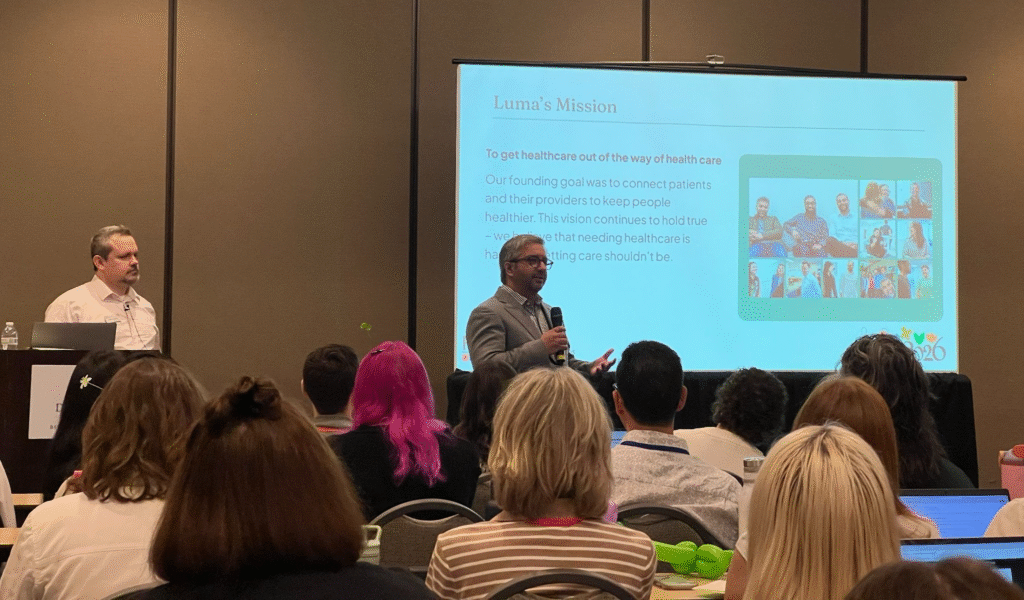
PCC announces new Luma-powered communications capabilities during the opening session of its 2026 Users’ Conference.
Josh Moore, Luma’s Senior Director of Channel, joined PCC at its 2026 Users’ Conference and saw the response firsthand.
“You could feel the energy in the room right away,” said Moore. “PCC’s customers are a close-knit group, and they were genuinely open about what’s working and what isn’t. That made it easy to see where we can help, and I came away even more excited about what we can build together.”
Luma co-founder and president Aditya Bansod was familiar with PCC for a more personal reason: his daughter’s pediatrician uses its technology.
“When I got to know the PCC team, it was clear why pediatricians trust them,” said Bansod. “Amidst all the noise in healthcare, PCC stays focused on independent pediatricians. They care deeply about the practices they serve and they solve problems in creative ways. That’s the kind of partner we want to build with.”
The impact of better communication for pediatrics
For practices, the value of the partnership will show up in ordinary moments: a parent who needs to reschedule, a provider who calls out, or a family that needs an answer without another round of phone tag.
Topeka Pediatrics is one of the PCC practices preparing to use the new capabilities. Practice Manager Brenna Zimmerman expects them to make a difference for both her staff and the families they serve.
“We’re looking forward to spending less time on manual communication and more time focusing on what matters most: caring for our patients,” Zimmerman said. “With this new platform, we’ll be able to communicate more efficiently while giving families a convenient and modern way to stay informed and engaged with our office.”
Pediatric practices shouldn’t have to simplify real family relationships to fit the way their communication technology is structured. The technology should already understand who is communicating, how that person is connected to the patient, and which child the conversation is about.
That means families get the information they need, staff spend less time managing communication, and pediatricians have more time to care for kids.