



As health systems move beyond chatbots and basic automation, a new vocabulary is rapidly entering the conversation: agents, orchestration, harnesses, MCPs, bounded autonomy, and agentic AI. Let’s decode what these terms actually mean and why understanding them can help leaders evaluate operational AI more effectively.
If you’ve sat through an AI demo recently, you’ve probably heard terms like agents, orchestration, harnesses, MCPs, bounded autonomy, or agentic AI.
The challenge is that vendors often use these terms differently. Ask three vendors what an AI agent is and there’s a good chance you’ll get three different answers. An “agent” in one platform may look very different from an “agent” in another.
That creates a real problem for health systems evaluating the next wave of AI systems. Leaders are trying to understand which systems can reliably move work forward, how much autonomy AI should have, and what governance controls are required as workflows become more dynamic.
When the same language describes very different capabilities, evaluating AI systems becomes harder than it should be.
Understanding the terminology helps leaders ask better questions about what AI systems can realistically do inside healthcare operations.
Health systems have already adopted the first wave of healthcare AI: chatbots, AI assistants, ambient listening, and summarization tools. Now they’re evaluating systems that can determine next steps, coordinate actions across systems, and keep work moving when conditions change.
That shift raises a new set of questions for health system leaders.
What happens when a workflow encounters an exception? How much autonomy should an AI system have? When should work be escalated to staff? How do organizations maintain visibility and control as systems become more capable?
Terms like agents, orchestration, harnesses, and bounded autonomy all emerged to address these questions.
Together, these concepts help clarify where healthcare operations may be headed and how leaders should evaluate AI systems.
This article is part of AI in Healthcare: Decoding the AI Shift Reshaping Healthcare Operations, a series designed to help health system leaders cut through AI hype and understand the operational AI transition now unfolding across healthcare.
In this second article in the series, we’ll decode the rapidly expanding language of operational AI, explain what these concepts actually mean inside healthcare workflows, and explore why orchestration, governance, and execution controls often determine whether AI-enabled workflows succeed in practice.
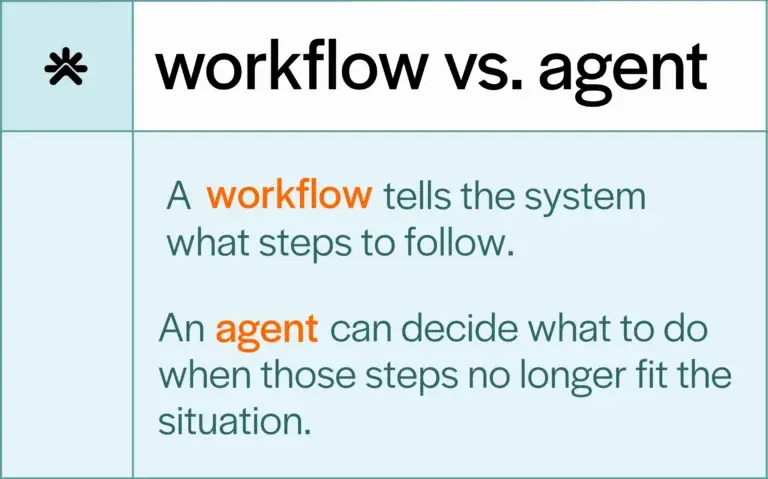
Workflows vs. agents: what’s the difference?
Workflow (noun): A sequence of operational steps that make sense…if everything goes perfectly. Agent (noun): An AI operator that can make game-time changes when everything doesn’t go perfectly.
Most healthcare operations already rely on workflows. A referral arrives. Eligibility is verified. The patient is contacted. An appointment is scheduled. Each step follows a predefined sequence.
That approach works well when conditions are predictable, but healthcare operations rarely stay predictable for long.
For example, referrals rarely move through healthcare operations exactly as planned.
A referral arrives missing required information. Outreach begins, but the patient never responds. Staff are too busy to keep chasing the follow-up manually, so the workflow stalls. Meanwhile, scheduling availability changes, insurance requirements shift, or new clinical information appears that changes what should happen next.
The further a workflow moves into the real world, the more exceptions it encounters.
That’s one reason agents have attracted so much attention.
A workflow tells the system what steps to follow. An agent can decide what to do when those steps no longer fit the situation. They can evaluate changing conditions, determine the next step, and adapt as new information becomes available.
Consider the referral workflow described earlier. A referral arrives missing required information. Outreach begins, but the patient never responds. Historically, staff would need to investigate what happened, determine whether additional information could be retrieved, decide whether escalation was necessary, and manually reconnect the workflow.
An agent-enabled system introduces more flexibility. The system may recognize that required information is missing, identify where that information can be found, attempt to retrieve it, determine whether escalation is necessary, and then continue the workflow automatically.
Importantly, the workflow hasn’t disappeared. It still provides structure, governance, and a clear objective. In most healthcare environments, agents are becoming part of the workflow, helping navigate complexity when workflows stop going according to plan.
In practice, most AI systems combine structured workflows with selective agent-like behavior. Some decisions remain tightly governed. Others allow greater flexibility when exceptions occur.
That’s why the word “agent” tells you very little on its own. The more useful question is how much decision-making authority the agent actually has.
Can it retrieve missing information? Can it determine the next step? Can it decide when to escalate work to staff? Can it adapt when operational conditions change?
Those questions reveal far more about a system’s capabilities than the label attached to it.
For healthcare leaders evaluating AI for healthcare operations, one question is especially revealing: What happens when the workflow doesn’t go according to plan?
The answer often tells you more than the demo’s happy path ever will.
What’s a harness, and why does it matter?
Harness (noun): The controls preventing your AI agent from confidently doing the wrong thing at scale.
As agents become more capable, health systems face new questions:
How much autonomy should an agent have?What actions should it be allowed to take on its own?When should work be escalated to staff?Who decides?
These questions help explain why harnesses are becoming increasingly important.
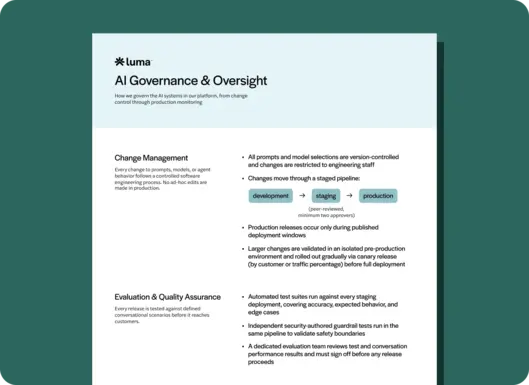
A harness is the control layer surrounding AI agents. It helps determine what the system can do, what rules it must follow, when work should be escalated, and how exceptions are handled.
Consider a scheduling workflow. An AI agent identifies appointment options, communicates with a patient, and recommends the next step. The harness determines what scheduling actions the system is allowed to take, what rules apply, what information and tools the agent can access, how it is guided through the workflow, and when staff involvement is required.
In healthcare, the difference between a useful agent and a risky one is often the layer of controls surrounding it.
Health systems can’t afford operational surprises. Patient safety, organizational policies, staffing realities, and regulatory requirements all place limits on what AI systems should be allowed to do. The more autonomy a system has, the more important those controls become.
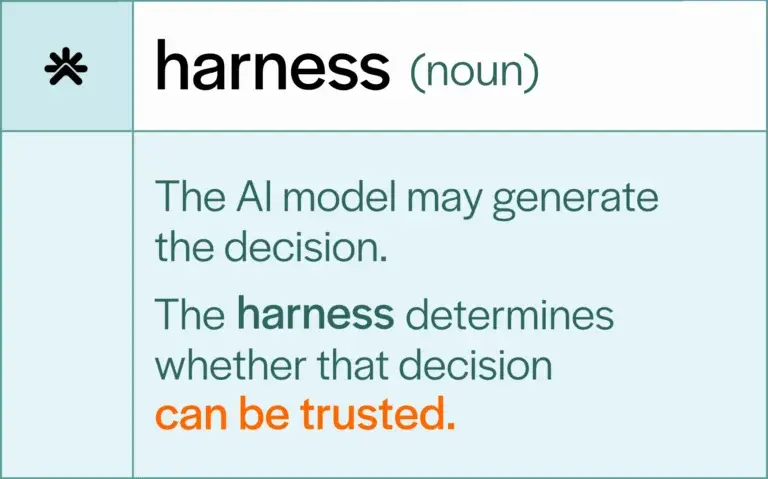
That’s why the AI model is only part of the story. It may generate the decision, but the harness determines whether that decision can be trusted.
That distinction matters when evaluating AI vendors.
Many AI demos focus on what the agent can do. But these demos need to include how the system is governed, how exceptions are handled, and what happens when decisions have operational consequences.
Two vendors may demonstrate similar AI capabilities during a demo. The differences often emerge in the controls surrounding those capabilities and how reliably they perform inside real operational environments.
As AI capabilities become more common, the real differentiators are orchestration, governance, and reliable execution.
Why healthcare requires controlled autonomy
Bounded autonomy (noun): Giving AI enough freedom to be useful, but not enough freedom to accidentally double-book a provider.
Many discussions about AI assume that greater autonomy is always better. Healthcare operations aren’t that simple.
Even with a strong harness in place, health systems still need to decide how independently AI systems should operate. A harness defines the boundaries. Bounded autonomy determines how much freedom the system has within them.
When should a system continue on its own? When should work be escalated to staff? How much flexibility is appropriate before human judgment is required?
This is often described as bounded autonomy: giving AI enough freedom to move work forward while operating within clearly defined boundaries.
In the previous scheduling example, the harness determined what scheduling actions the system was allowed to take. Within those boundaries, the system still needs to determine when it can continue independently and when staff should become involved.
The system may verify eligibility, identify appointment options, contact the patient, and schedule the visit. But if required information is missing, scheduling rules conflict, or a patient request falls outside established parameters, the system may escalate the situation to staff.
People remain part of the process when judgment, oversight, or intervention is needed.
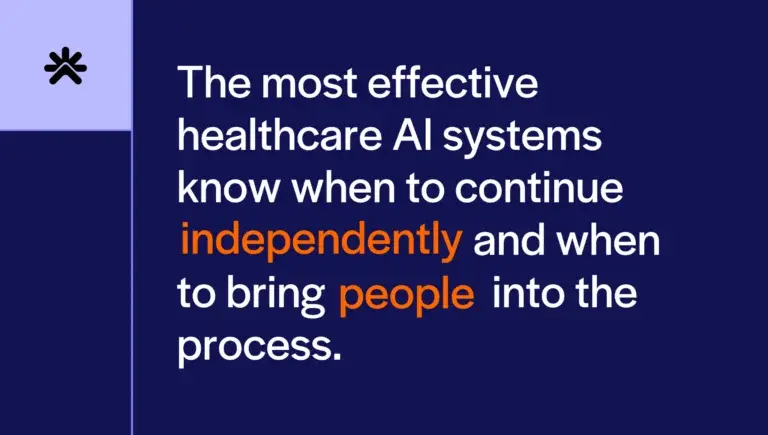
The most effective healthcare AI systems know when to continue independently and when to bring people into the process.
How healthcare leaders should evaluate AI systems
AI demo (noun): A carefully controlled environment where nothing unexpected ever happens.
AI demos are designed to showcase capability. Real healthcare operations test reliability.
Patients provide incomplete information. Scheduling rules conflict. Insurance requirements change, referrals arrive with missing documentation, and operational priorities shift throughout the day. The operational complexity removed from a demo eventually shows up in production.
That’s why health systems need AI systems that can reliably move work forward inside real healthcare environments.
Throughout this article, we’ve explored concepts like agents, harnesses, and bounded autonomy. Each describes a different aspect of how AI systems behave in operational environments. Together, they provide a useful framework for evaluating AI systems in practice.
Health system leaders should ask:
- How does the system coordinate work across systems?
- What governance, escalation, and operational visibility controls exist?
- How does the system handle ambiguity and operational exceptions?
- What operational tasks can actually be completed reliably?
These questions shift the conversation from terminology to operational performance. They help reveal how a system behaves when workflows become complex, information is incomplete, and conditions change unexpectedly.
In healthcare operations, reliable execution, orchestration, and governance often matter more than impressive AI capabilities alone.
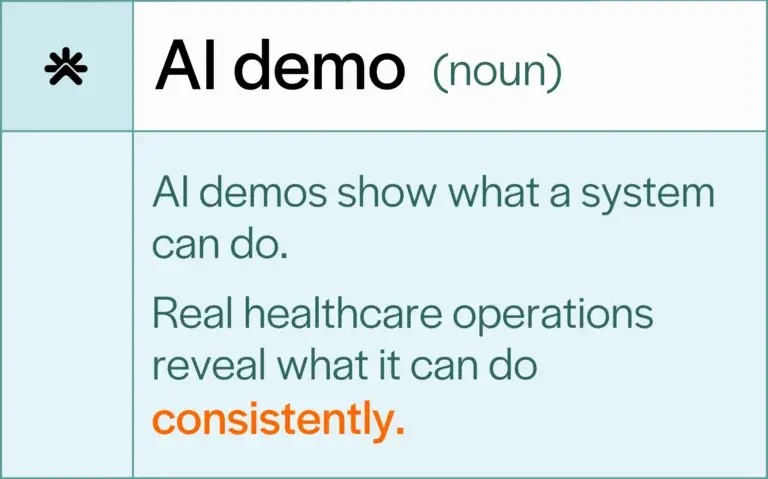
AI demos show what a system can do. Real healthcare operations reveal what it can do consistently.
In the next article in this series, we’ll move from terminology to implementation, exploring how health systems can define meaningful operational goals, outcomes, and success metrics that help AI initiatives deliver measurable results.