




Healthcare operations don't stall because the tools fail. They stall because nothing owns what happens next. This release is about changing that.
Health systems have spent years adding tools to their operational stack. Most of those tools do exactly what they're supposed to do. Industry-wide, the problem is what happens in between.
A no-show is logged? Someone has to notice and call down a list. A screening result arrives by fax? Someone has to open it, read it, and decide what happens next. An intake form sits incomplete? Someone has to catch it before the appointment.
The work stalls between steps because coordination between systems still falls to staff. That's the gap Luma has spent a decade building toward closing. In 2025 alone, Luma's AI saved 2.5 million staff hours by connecting operational work end to end.
Your staff has too much on their plate to be the manual connector between every workflow. Luma's Spring '26 Release focuses on AI workflows that finish the job, taking work off their plate instead of moving it around.
Launch AI workflows that run themselves with Workflow Builder
Available for Early Access
Most healthcare operations leaders already know exactly what should happen when a patient no-shows, a slot opens, or an intake form sits incomplete. The challenge is operationalizing that logic so that it runs automatically and adapts when operations evolve. Until now, that meant development requests, implementation timelines, and your staff absorbing manual gaps and waiting on better workflows.
Workflow Builder closes the gap. It's Luma's no-code orchestration engine, now generally available. Your operations team defines the trigger and the logic. From there, Luma carries the workflow forward across products until the outcome is reached.
You don't start from a blank page. Its connected Workflow Gallery features a pre-built library of workflows your team can launch immediately and customize to match how your organization actually operates. No IT Team needed, no implementation tickets, no waiting. Here are just a few:
- Recover abandoned self-scheduling: When patients don’t finish scheduling with you, follow up to get them on the schedule.
- Recalls and follow-ups: Ensure patients get the follow-up they need.
- Recover canceled appointments: Get patients back on the schedule after a cancellation to avoid missed or delayed care.
See Workflow Builder in action:
Get patients back on the schedule after no-shows with conversational AI outreach
Available for Early Access
Missed appointments carry real clinical and financial consequences. They're a patient retention challenge as much as a scheduling one.
Across medical groups, no-show rates typically fall between 5% and 7%. At scale, that translates into meaningful revenue loss. Industry estimates put the annual cost of missed appointments at $150 billion in the U.S. Each missed appointment is a staffed visit that never happens.
The operational issue is what happens next. Most health systems still rely on manual follow-up: staff review reports, build call lists, and try to reconnect with patients one by one. That process is time-consuming and inconsistent. Some patients are reached quickly. Others fall through the cracks.
The consequences extend beyond the missed visit. Patients who miss appointments often struggle to get back on the schedule and may miss out on needed care. Delays compound quickly. Research shows that longer wait times are directly associated with higher no-show rates. In one analysis, each 30-day increase in wait time was linked to a 25% increase in no-shows. That means access problems and recovery problems compound each other. Once a patient is out of the system, bringing them back becomes harder with each passing week.
This creates a persistent failure mode in healthcare operations. Demand exists, capacity exists, but without a reliable way to recover missed visits, both are lost.
Why appointment recovery needs to happen immediately
The window to bring a patient back is short.
A missed appointment is a moment where intent is still high. The patient already engaged once. If outreach happens quickly and the next step is easy, many of those visits can still be recovered. If it doesn’t, that intent fades. Patients delay, seek care elsewhere, or drop out entirely.
For operations teams, this becomes a constant tradeoff. Do you allocate staff time to chasing missed appointments, or focus on the work in front of you? In most environments, recovery is inconsistent because it competes with everything else.
Recover patients automatically with conversational AI outreach
Navigator, Luma's Conversational AI Agent, already handles inbound access at scale, guiding patients through scheduling, cancellations, and more across voice and SMS without staff involvement.
That capability now extends to outbound recovery. When an eligible no-show occurs, Navigator carries the recovery workflow through to completion:
- The patient is identified and contacted.Navigator places an outbound call using conversational AI.
- The patient is guided to reschedule.During the interaction, the patient can immediately book a new appointment.
- The visit is recovered in real time.The system completes the rescheduling without staff follow-up or manual outreach.
Eligibility criteria and outreach timing are configured through Workflow Builder, so each organization can define how recovery should work based on visit type, patient segment, or operational priorities.
That logic runs automatically every time a no-show occurs. More visits are recovered, schedules stay full, and patients return to care without delay.
See Navigator in action:
Turn faxed results into completed follow-up and closed care gaps with AI
Fax remains an essential part of daily operations across health systems, with clinical results arriving at high volume. Yet many organizations still rely on staff to review results, interpret findings, and coordinate next steps manually. As volume increases, results pile up in queues, delaying follow-up. A result may be received and routed, but if it sits in a queue, it does not move care forward or close a care gap. As the National Committee for Quality Assurance (NCQA) notes, failure to complete timely follow-up after abnormal screening can undermine the value of the screening itself, impacting both patient outcomes and performance under value-based contracts.
Even as fax ingestion, routing, and queue visibility have improved, this gap remains. The last mile still depends on staff capacity, with delays that affect both patient outcomes and quality performance.
Why timely follow-up on faxed clinical results matters
When a faxed clinical result sits in a queue instead of triggering immediate follow-up, a real human patient must wait for answers as diagnosis and treatment are pushed further out.
Take an abnormal mammogram screening result. Follow-up after abnormal imaging is expected within a defined window, but when that follow-up is delayed, the path to diagnosis can slip.
The NCQA now measures whether patients with inconclusive or high-risk breast imaging receive follow-up within 90 days, and notes that delayed follow-up after abnormal mammography has been associated with decreased survival, particularly in underserved populations.
Close care gaps automatically with clinical intelligence
Fax Transform, Luma’s Document Flow Agent, already parses incoming documents, routes them to the right teams, and integrates with downstream workflows, helping health systems manage volume without adding staff.
That capability now extends from routing to completing the work. When a faxed clinical result arrives, Fax Transform carries the workflow through to completion:
- The result is read and interpreted.The system extracts the clinical content and identifies whether the finding is normal or abnormal.
- The result is routed into the appropriate workflow. Instead of sitting in a queue for manual review, it moves directly into follow-up.
- The next step in care is triggered.
Normal results are documented and closed. Abnormal findings trigger the appropriate next step, whether that’s patient outreach, scheduling, or ongoing monitoring. - The workflow is completed end to end.The system notifies the patient, updates the health maintenance record, and schedules follow-up based on clinical guidance.
See Fax Transform in action:
Workflow Builder, Navigator's outbound rescheduling for no-shows, and Fax Transform's clinical intelligence capabilities are just three highlights from our full Spring '26 release. The release includes more enhancements, like batched waitlist outreach that fills open slots automatically and Navigator's ability to schedule new patients without transferring to staff, all building toward a standard where healthcare operations don't depend on staff to connect the steps. Luma customers can read about our Spring ‘26 release in detail here.
Luma's Spring '26 release moves healthcare operations closer to the standard they've needed for a long time, one where the work runs itself end to end and finishes the job, so your team can focus on what only they can do. If you’d like to see what this looks like in your environment, we're happy to walk through it.
Customer stories:
- Case Study: DENT Neurologic Institute Processes 15x More Faxes with Luma's AI
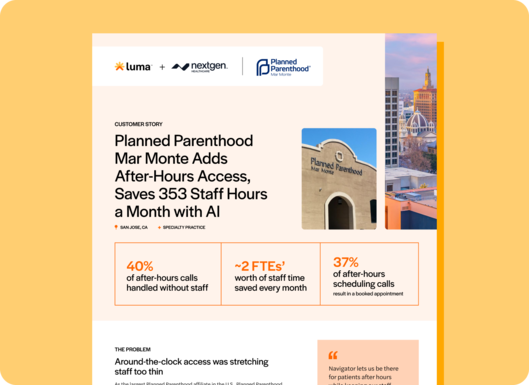
- Case Study: UAMS Automates 95% of After-Hours Calls with Luma's Navigator
Further reading:
Cara Evangelista