





How healthcare marketers can measure the revenue impact of an ad conversion, identify growth opportunities, and compare to competitors
A health system hires three orthopedic surgeons, and marketing is tasked with helping fill their schedules.
A few months later, leadership wants answers. How many new patients did marketing campaigns bring in? Which campaigns generated appointments and revenue? Should the organization invest more in orthopedics, or focus somewhere else?
Those sound like straightforward questions. In many health systems, they’re surprisingly difficult to answer.
Healthcare marketers are being asked to drive service line growth, support physician recruitment, expand into new markets, and contribute to revenue goals – but they lack the full schedule visibility to most effectively do so.
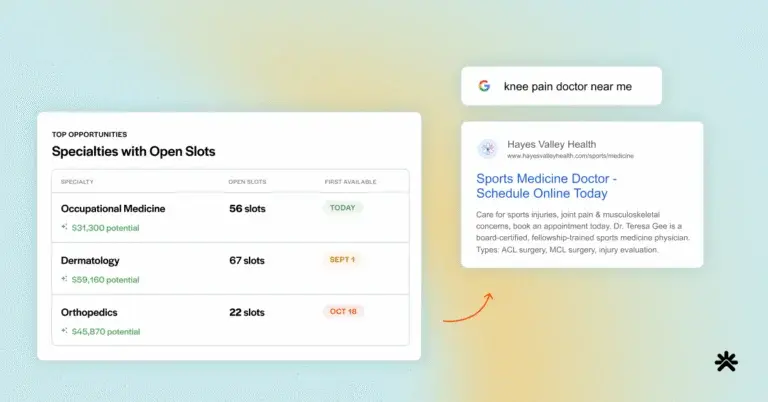
Luma’s Patient Pipeline fills this gap. Marketers can see exactly which ads led to booked appointments and how many visits can be attributed to the initial click. Then, they can dig into why. Instead of working with priorities like “book more orthopedic appointments,” marketers can see details like which services competitors offer and which of their own high-value services are underbooked – and then automatically buy and serve ads incorporating these insights to drive more conversions.
The Access-Marketing Gap
Over a decade working with scheduling systems, provider availability, patient demand, and the workflows that connect patients to care, we kept running into a gap between marketing and patient access.
Marketing and access leaders told us they were often working toward the same outcome. Marketing wants to help patients discover care. Access wants to help patients schedule and receive it. Both are trying to connect a patient with the right provider at the right time.
But many of the growth and revenue decisions marketers are asked to make depend on information in the EHR that they can’t see. They might know to prioritize orthopedics and a new pediatric clinic, but they can’t see that a newly hired surgeon has dozens of open appointments, or that one clinic is full while another has same-day availability.
We realized that marketers needed a better way to use operational data to guide growth and investment decisions. That became the foundation for Patient Pipeline.
How Patient Pipeline Helps Marketers Make Better Growth Decisions
Patient Pipeline is the newest product in Luma’s Operational AI platform. It helps healthcare marketers find where to grow, connect patients with available care, and measure what those efforts return.
It watches your MyChart Open Scheduling availability and checks it regularly. When a provider or service line has openings, Patient Pipeline can promote those appointments through Google Ads and AI search to nearby patients looking for that care. Then it follows each patient from the ad to the booked appointment and the care that comes after – all while keeping PHI inside your EHR.
The information you need to make better growth decisions is already inside your organization. Patient Pipeline puts it to work.
Find your openings and compare to competitors
You might know orthopedics is a priority. You might not know that a newly hired surgeon still has open slots this week, or that the health system across town is easier to find and schedule with.
Patient Pipeline shows which providers and service lines have availability now, where you have room to grow, and how your access compares to nearby competitors on specialty mix and ease of scheduling. Some service lines grow your patient base. Others drive most of your revenue. Patient Pipeline helps you tell them apart before you spend.
Capture patient demand dynamically
Your current Google ads might create awareness, but lack the trackable demand capture and the real-time schedule data that could make them even more effective.
Patient Pipeline generates Google ad copy, keywords, filtering, and more based on changes in your real appointment availability. New ads are ready to go fast, and if an ad needs to change (e.g., a provider is on PTO) it’s flagged for you right away.
Instead of guessing at your ads’ effectiveness or waiting for an agency to update ads, you have the tools to capture patient demand in the moment.
Report on the revenue after the click
Even when your ads convert and a patient schedules an appointment, the impact rarely stops at one visit. For example, a first orthopedic appointment often leads to imaging, a follow-up, and a procedure. These thousands of dollars of care might never be connected back to the initial marketing efforts that brought in a new patient.
But until now, you might not have seen that impact with reporting limited to clicks and leads.
At University of Arkansas for Medical Scienes (UAMS), 45 patients who saw a Patient Pipeline ad booked an orthopedic visit, and patients who came in through an ad went on to receive five or more visits. The program returned $2.50 for every dollar spent and created $27,400 in orthopedics revenue in a single campaign.
At Charlotte Ear Eye Nose and Throat Associates (CEENTA), a campaign to fill ENT schedules garnered 8x ROAS and 8,000 impressions from local patients searching for care.
Patient Pipeline ties the full journey together, so you can show what acquisition actually returned and use that to decide where to spend next.
Adjust as your market changes
Patient Pipeline lets your team launch well-targeted campaigns quickly, then keeps tuning them as real results come in.
Say you’re promoting orthopedics across two locations. After a few weeks, one clinic has filled its open slots while the other still has room. Patient Pipeline can shift spend toward the location that still needs patients, instead of paying to advertise appointments that are already booked. The same thing happens at the provider level. As a newly hired surgeon’s schedule fills, the focus can move to the next provider who needs a fuller panel.
When a service line fills up, demand moves, or a competitor changes what they offer, Patient Pipeline adjusts so your budget follows the openings that still need patients.
Helping marketers take action without the information gap
Today the work of growth is split across agencies, analytics dashboards, scheduling systems, and market research. Each one answers a single question, and none of them talk to each other. Patient Pipeline brings the whole journey into one place: where to grow, how to reach patients, and what it returned.
Patient Pipeline equips you with the data and insights you need to close the loop, make a bigger impact with your investments, and show that marketing drives growth.
Learn more about Patient Pipeline.