From Automation to Orchestration: How Operational AI Is Reshaping Healthcare Operations

Health systems have automated tasks for years. Now they need systems that can run operations end to end. Luma Health is driving the shift to Operational AI: platform-driven agentic orchestration that executes healthcare workflows across the EHR and downstream systems. Agentic AI makes this possible now, at a level that felt out of reach just a few years ago.
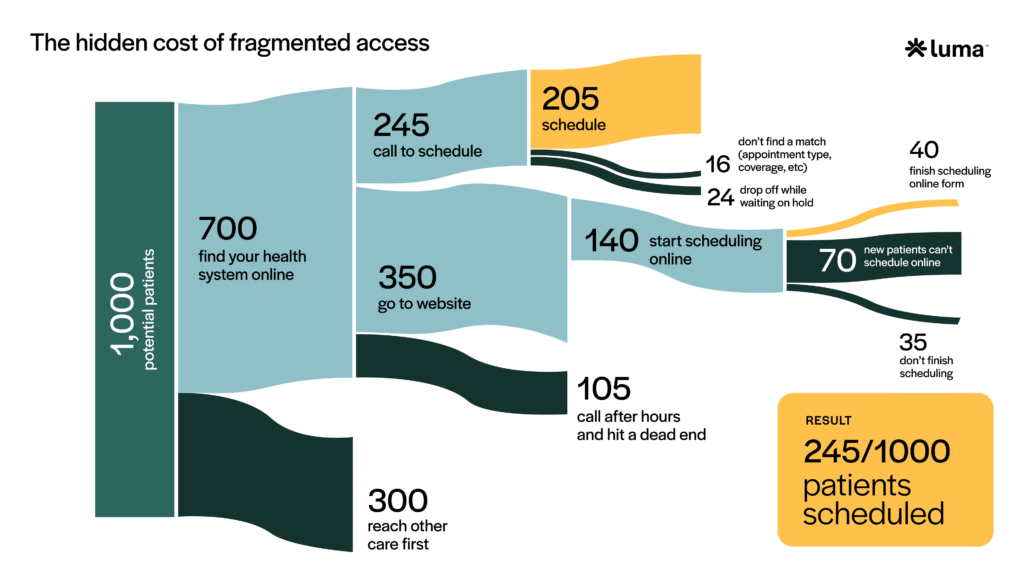
Healthcare has invested heavily in digital transformation over the past decade. Portals. Reminders. Chat bots. Open scheduling.
On paper, it looks impressive. But if the fancy tech still leads to a dead end, it isn’t progress. It’s friction with better branding.
Access bottlenecks persist. Referrals stall. Orders go unscheduled. No-shows remain stubbornly persistent. Even health systems running the best EHRs and deploying AI still struggle with fragmented workflows and manual coordination behind the scenes.
Adding more digital layers doesn’t solve operational gaps. It often multiplies handoffs, adds complexity, and leaves staff stitching processes together manually. It also increases vendor overhead, from managing contracts and integrations to coordinating disconnected workflows across platforms.
At Luma, we believe AI has to do more than automate a task or send a message. It has to own complex operational outcomes. Agentic AI makes this possible now, at a level that felt like science fiction just a few years ago.
Operational AI runs healthcare workflows end to end, coordinating work across the EHR and downstream systems so referrals move, appointments fill, follow-ups happen, and revenue isn’t lost in the gaps. Instead of staff manually chasing missing information, monitoring handoffs, and resolving breakdowns between systems, AI agents continuously monitor workflows, identify exceptions in real time, resolve issues proactively, and escalate only when human judgment is required. It’s the shift from stacking tools on top of broken workflows to orchestrating the successful execution of complex healthcare workflows.
Beyond Automation: What Operational AI Actually Means
Operational AI focuses on system-level execution, coordinating towards an outcome rather than isolating single steps. When a referral arrives, the system goes well beyond just logging it. It parses it. Routes it. Triggers downstream scheduling. Engages the patient. Closes the loop with the referring provider. It ensures the next step happens seamlessly.
Powered by Spark, Luma’s AI core, our agents coordinate work across Access, Engagement, Intake, and Payment Capture, operating with shared context informed directly by EHR data.
Spark’s orchestration makes execution predictable at scale across teams and systems without manual intervention at every handoff.
It’s the difference between sending a reminder and ensuring a patient completes the next step in care, or flagging a prior authorization issue and resolving it from verification through scheduling.
Health systems are demanding predictable AI outcomes. Operational AI delivers that by orchestrating and owning workflows end-to-end.
How Luma’s Operational AI Platform Runs the Healthcare Journey
Luma’s platform spans four interconnected categories of operational work:
- Access. New patient acquisition, referral and fax workflows, order orchestration, scheduling and rescheduling, and waitlist management.
- Engagement. Conversational patient access, intelligent messaging, and patient-initiated interactions across channels.
- Intake. Responsive intake and registration, real-time urgent care and walk-in queue management, clinic flow optimization, and coordinated patient and staff readiness checklists.
- Payment Capture. Eligibility verification, prior authorization support, and copay and past balance collection.
Together, these form a connected system of execution that replaces fragmented handoffs with coordinated workflows.
Across the U.S. and internationally, health systems are already using Luma’s Operational AI platform to reduce administrative burden and recover capacity. In 2025 alone, Luma-powered AI workflows saved 2.5MM staff hours, handled 350,000+ care-related next steps, and powered hundreds of agentic workflows including intelligent no-show recapture, post-discharge follow-up, and closed-loop referral management. Luma recently shared additional momentum and roadmap details in our official announcement.
Health System Impact of Operational AI
Health systems deploying Luma’s Operational AI platform are seeing measurable operational gains:
- Banner Health, a large multi-state integrated delivery network, resolved 70% of imaging-related patient messages with Luma’s Conversational AI, autonomously handling 2,300+ conversations in one year, reducing manual inbox triage by 70%, and delivering responses an average of six hours faster.
- UAMS (University of Arkansas for Medical Sciences) now handles 95% of after-hours calls with Luma’s AI, saving more than 800 call center hours annually and enabling 10,000+ calls per year to be resolved by AI instead of staff.
- Northfield Hospital + Clinics now processes more than 3,000 faxes per month with 95% handled by AI at a 95.5% success rate, reducing fax handling time by 90% and saving more than 250 staff hours every month. Learn more at the upcoming ViVE 2026 presentation, “How AI Fixed a Hidden Fax Drain on Staff Time,” with Northfield’s Debbie Oathoudt.
- Phelps Memorial Health Center, a rural Nebraska health system, reduced fax handling time by 85% with Luma’s Order Management Agent, processing 400+ faxes per month and saving a Health Information Management staff member an hour every day.
Agentic Workflows in Action
Fax-based workflows remain one of healthcare’s most persistent operational bottlenecks.
Luma’s Document Flow Agent automates referral intake, prescription refill requests, and ROI processing without manual sorting or follow-up for staff. At DENT Neurologic Institute, which processes hundreds of faxes for high-value specialty services every day, automation of fax workflows represents significant efficiency gains. When a referral is processed, Spark triggers downstream workflows like patient outreach and self-service scheduling, and closes the loop with referring providers.
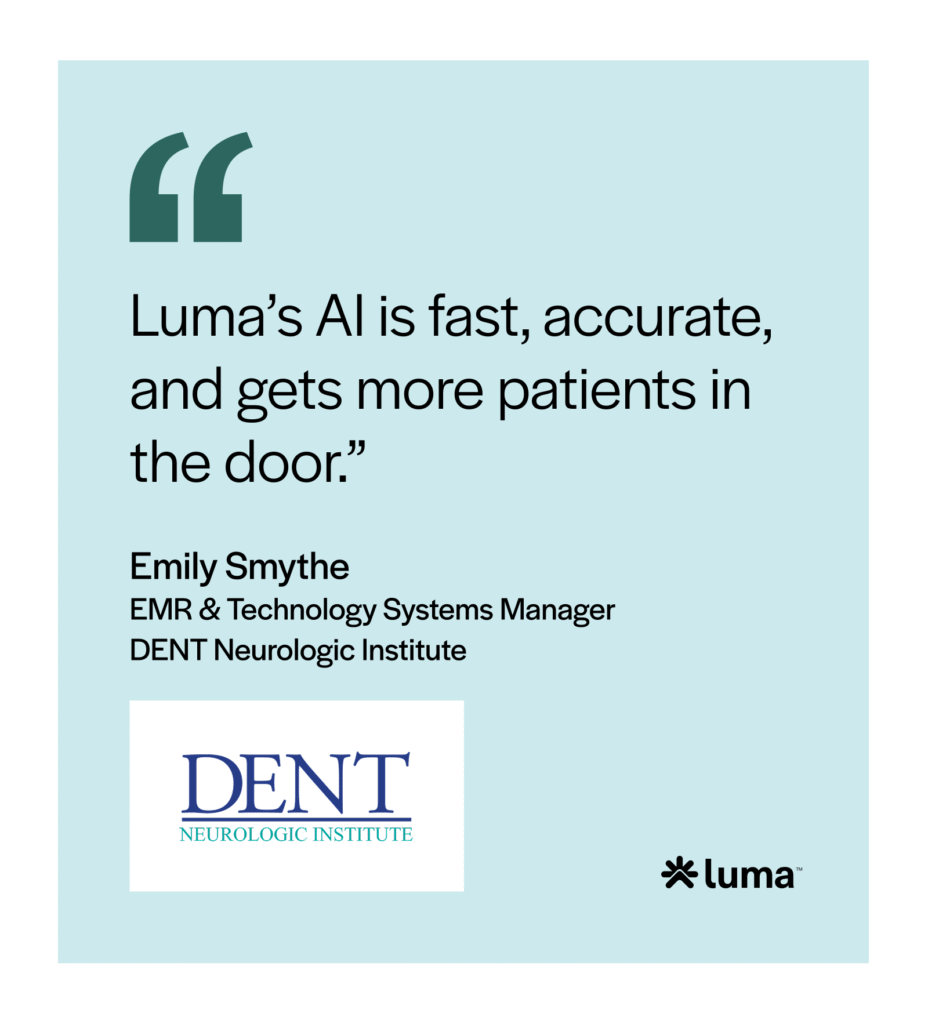
“Faxes often create bottlenecks that require staff working manually to avoid delays in care, and at a large specialty organization like DENT the volume is unsustainable,” said Emily Smythe, EMR & Technology Systems Manager. “Luma’s AI is fast, accurate, and gets more patients in the door.”
Luma’s Conversational Agent acts as an omnichannel concierge, handing off to the Scheduling Agent to manage appointments directly in the EHR. At Sun River Health, the agent now manages a large share of inbound patient access interactions, reducing call abandonment by more than one-third and cutting average call answer times by 75%.
These are agentic workflows. Multiple coordinated agents working together across systems to move work forward autonomously.
Why This Shift Is Accelerating Now
Health systems are consolidating vendors. They’re demanding measurable outcomes. They can’t afford fragmented automation layered on top of fragile manual coordination.
Operational AI shifts organizations from reacting and staffing up to focusing on more meaningful work.
Leaders can design workflows that carry work from start to finish and govern agentic processes that are already in motion, rather than relying on teams to chase handoffs or monitor dashboards.
This is a structural shift in how healthcare operations are designed.
What’s Next in 2026
Luma’s platform continues to evolve as health systems expand their use of Spark-orchestrated workflows.
Near-term roadmap highlights include:
- Outbound Conversational Coordination. Luma’s Conversational Agent will expand beyond inbound requests to proactively identify incomplete next steps. By reviewing EHR data, visit notes, and prescriptions, it will automatically reach out to patients to reduce missed follow-ups.
- Prior Authorization Coordination. Luma’s Order Management Agent will manage prior authorization end to end, from insurance verification to payer outreach and scheduling after approval, helping shorten clearance timelines and prevent delays.
- AI Workflow Builder. Health systems will be able to design and govern multi-step AI workflows directly within Luma, extending Operational AI across teams without custom development or third-party tools.
This is how Operational AI scales.
From Automation to Infrastructure
For more than a decade, Luma has focused on preventing digital dead ends and moving patients to the next step in care. AI now enables something bigger: orchestration.
As health systems continue to face workforce constraints and rising demand, execution cannot depend on manual coordination. It must be designed into the system.
That shift from automation to orchestration is already underway, and we’re excited to continue scaling Operational AI across the healthcare industry in 2026.
Resources:
- Accelerating Healthcare Operations with Operational AI
- Luma’s Document Flow Agent (Product Overview)
- Luma’s Conversational Agent (Product Overview)
- Case Study: UAMS Automates 95% of After-Hours Calls with Luma’s Navigator
- Case Study: Banner Health’s Conversational AI Agent Cuts 70% of Staff Inbox
- Case Study: DENT Neurologic Institute Processes 15x More Faxes with Luma’s AI
- Case Study: Phelps Memorial Health Center Slashes Fax Burden by 85% – with No Extra Staff