Containment Rates in Voice AI: Not All “Contained” Calls Are Equal
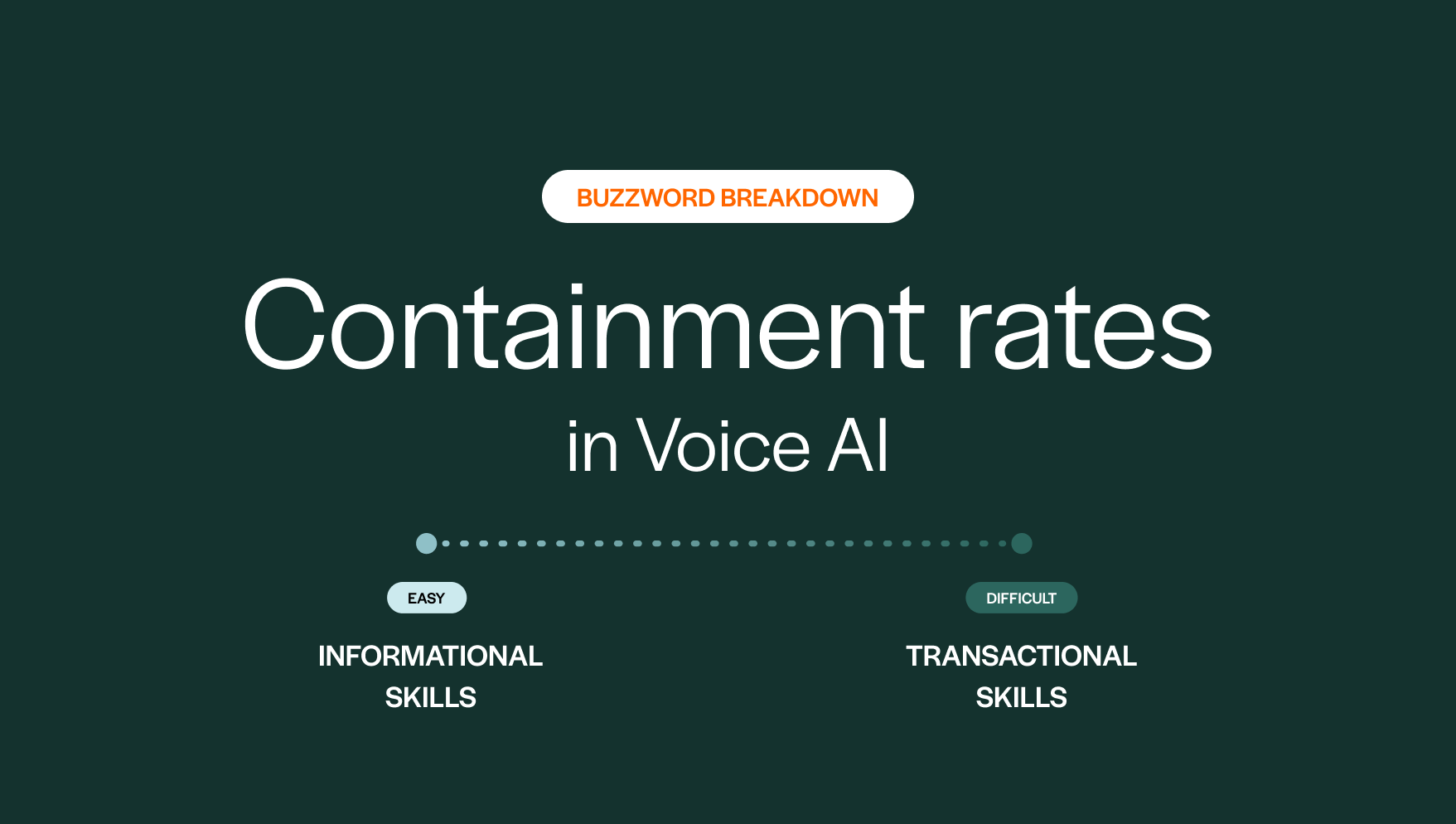
When a vendor shows you a 90% containment rate, your first question should be, “For which skills?” That number can reflect simple informational calls or complex, fully completed workflows. The difference determines how much real operational impact the metric represents.
“Containment rate” comes up in nearly every conversation about voice AI. But when we ask buyers what it means, we get different answers every time.
So let’s be clear. Containment rate means the percentage of calls a voice AI system handles completely, without transferring to a human agent.
A call is “contained” when the patient gets what they need: appointment scheduled, question answered, reminder confirmed, entirely through the automated system.
Sounds simple. But here’s where it gets complicated: not all contained calls are equal.
Telling a patient where to park is easy to contain. Scheduling a new appointment with full EHR integration, insurance verification, and provider-specific availability is a completely different challenge.
Voice AI Capabilities Exist on a Spectrum of Complexity
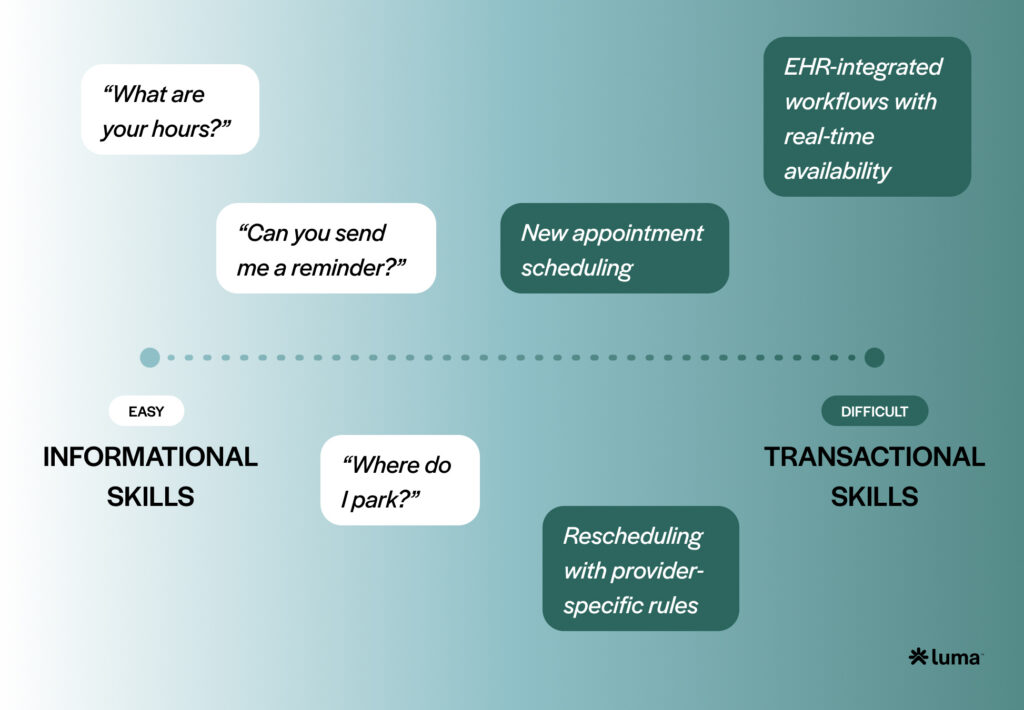
On one end, voice AI accomplishes informational skills.
For example, questions like: “What are your hours?” “Where do I park?” “Can you send me a reminder?”
These are fast, rule-based, and highly containable. 60–90% containment is realistic.
On the other end, can your voice AI vendor accomplish transactional skills?
New appointment scheduling. Rescheduling with provider-specific rules. EHR-integrated workflows with real-time availability.
These transactional skills are harder. There are more variables. More failure points. Containment rates naturally drop, and that’s expected.
When a vendor shows you a 90% containment rate for a voice AI solution, your first question should be: “for which skills?”
Mixing easy skills, like answering a pre-defined question, and hard skills, like rescheduling, into a single headline number can allow vendors to create impressive-looking metrics on a weak foundation. And when you’re ready to use the technology to go beyond simple FAQs, your chosen vendor might fall flat.

What Containment Actually Means in Dollars
Containment metrics below 50% sound modest until they’re converted into dollars.
When healthcare operators first see containment rates, their reaction is often the same: “Is that enough?”
That’s the wrong question. The right question is: What does that number actually save?
Consider what a single handled call represents in costs:
- Agent time (not just talk time; after-call work too)
- Training and onboarding costs
- 24/7 and weekend coverage premiums
- Hiring and retention overhead
When you factor in variables beyond labor cost per minute, even a 30% containment rate on a high-volume call center starts translating into millions of dollars annually.
We’ve seen the math run in real customer environments. The dollar impact is usually larger than people expect.
Containment rate alone doesn’t tell you much, so don’t evaluate a voice AI solution on that alone. Build the model. Convert the percentage to a dollar figure that reflects your actual cost structure.

Why High Containment Rates Often Miss the Point
When you see a 90% containment claim, ask: “Does that number include new patient appointment scheduling with full EHR integration?”
In our experience, the answer is almost always no.
It’s easy to hit high containment rates when you define success narrowly as addressing low-complexity tasks such as informational queries, simple confirmations, or static FAQs. These are real use cases, but they’re not the reason healthcare systems are investing in voice AI at scale.
The hard work, the work that actually moves the needle on access, efficiency, and patient experience, is transactional scheduling. This involves more than just retrieving information. It requires booking or changing appointments in real time inside the EHR, with provider availability, slot logic, and patient-specific constraints. It requires the system to make decisions, handle exceptions, and commit changes in real time.
No one in this industry is hitting 90% on that.
When evaluating a vendor, your benchmarks should be:
- Is this meaningfully better than a modern IVR?
- Is the measurement methodology transparent?
- Are hard and easy skills reported separately?
How to Evaluate Voice AI Vendors on Containment
Containment rate only matters if you can understand how it’s measured and what it represents in practice. So, in your next vendor evaluation, be sure to ask:
- What’s your containment rate broken out by skill type?
If they give you a single blended number, press harder. Simpler tasks and more complex, transactional workflows should be reported separately. - Does your containment rate include new appointment scheduling with EHR integration?
This is the hard test. It filters out vendors whose numbers are built on informational use cases. - How do you define a ‘completed’ interaction?
Is completion based on a clear outcome, such as an appointment actually booked in the EHR, or an inferred result? The answer tells you how rigorous their measurement is. - Can you convert your containment rate into a dollar value for our environment?
Vendors who’ve done this before will have a clear model tying containment to labor, throughput, or cost savings. Those who haven’t will stall. - What’s your methodology for intent classification and how is it validated?
This is advanced, but the answer reveals how reliably the system understands requests and how well the underlying AI is built, tested, and improved over time.
Containment rate is easy to quote. What matters is what the system is actually completing and how that’s measured.
The right vendor will welcome these questions.
The wrong ones will redirect to a demo.